
Beautiful Plants For Your Interior
Beautiful Plants For Your Interior

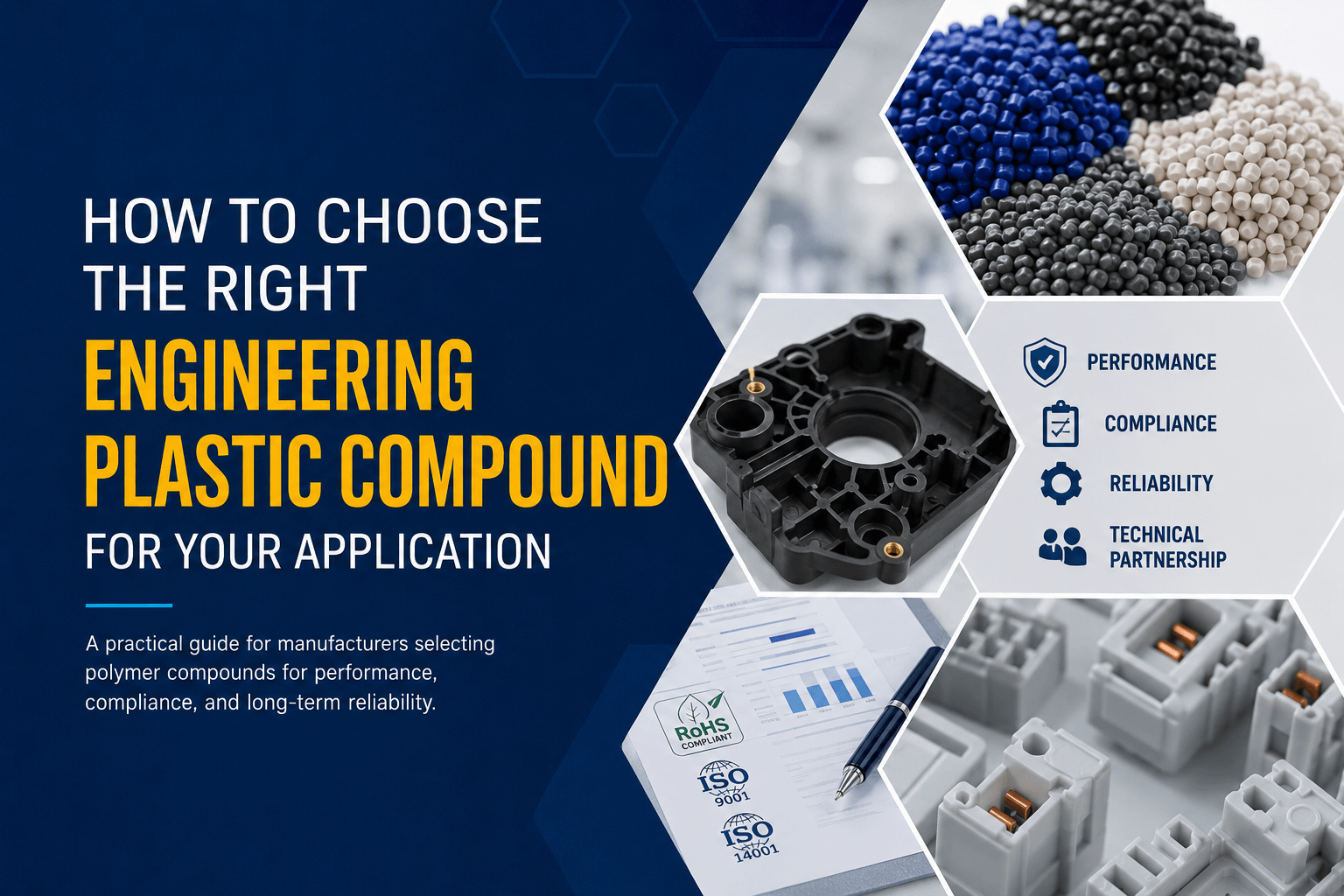
Choosing the right engineering plastic compound is not simply about selecting a resin type. For manufacturers, the material used in a product can directly affect performance, safety, durability, production efficiency, and long-term reliability.
A suitable compound should match the application’s mechanical, thermal, electrical, environmental, and regulatory requirements. This is especially important for demanding industries such as automotive, electronics, electrical, construction, and industrial components, where product failure can lead to costly delays, customer complaints, or compliance risks.
At CIPC, engineering plastic compounding is approached as a technical process. It involves understanding the customer’s application, selecting the right base resin, formulating with suitable additives or reinforcers, testing the compound, and ensuring consistent production quality.
Every material selection should begin with one question:
What does the final product need to achieve?
Different applications require different performance characteristics. For example, a plastic component used in an automotive part may require high strength, heat resistance, dimensional stability, and long-term durability. Meanwhile, an electrical or electronic component may require flame retardancy, anti-static properties, RoHS compliance, or tight colour consistency.
Before selecting a compound, manufacturers should consider:
A good engineering plastic compound should not only perform well in theory. It should work reliably in the actual application environment.
The environment where the product will be used plays a major role in material performance.
Some plastic components may be exposed to heat, moisture, friction, chemicals, UV light, or electrical stress. If these factors are not considered early, the selected material may deform, crack, fade, wear out, or fail during use.
For example, parts used near engines or electrical systems may need better thermal resistance. Components exposed to repeated movement may require wear-resistant or lubricated compounds. Products used in electronics may require conductive, anti-static, or flame-retardant material solutions.
This is why custom formulation matters. Instead of using a standard resin, manufacturers can work with a compounding partner to develop a material that meets specific operating conditions.
For global manufacturers, material compliance is no longer optional. Many industries must meet strict environmental and safety standards before their products can enter international markets.
One important example is RoHS compliance, which restricts the use of certain hazardous substances in electrical and electronic products. Manufacturers may also need heavy metal-free compounds that meet strict parts-per-million requirements.
Choosing a compound without considering compliance can create serious risks, including failed customer audits, rejected shipments, delayed production, or restricted market access.
CIPC supports customers with compounds developed for strict compliance expectations, including RoHS-compliant and heavy metal-free requirements. With quality and environmental systems such as ISO 9001, ISO 14001, and Sony Green Partner recognition, compliance is treated as part of the material development process, not an afterthought.
Different product challenges require different types of engineering plastic compounds. The right choice depends on the performance target.
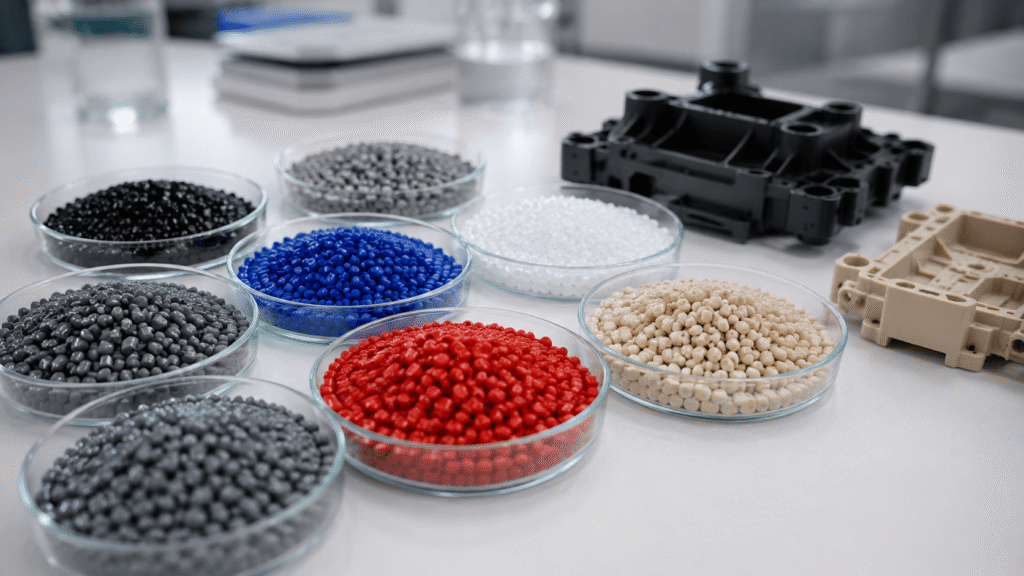
For example:
Glass fiber reinforced compounds are suitable when strength, stiffness, and dimensional stability are important. These are often used in structural or demanding industrial parts.
Lubricated and wear-resistant compounds are designed to reduce friction and improve long-term movement performance.
Mineral-filled compounds can help improve dimensional stability, stiffness, and processing performance.
Conductive or static dissipative compounds are useful for applications where electrical properties are important.
Elastomer-filled compounds may be selected when flexibility, toughness, or impact resistance is needed.
Pre-coloured compounds help manufacturers achieve consistent appearance and reduce the need for additional colouring processes during production.
The key is not to choose based only on material name. Manufacturers should choose based on what the final product must do.
A technically suitable material must also be practical for production.
Even if a compound meets performance requirements, it must still process consistently during injection moulding, extrusion, or other production methods. Poor material consistency can cause defects such as warpage, short shots, colour variation, poor surface finish, or unstable mechanical performance.
This is where compounding quality becomes important.
Advanced blending and extrusion technology help ensure that additives, fillers, reinforcers, pigments, and base resins are distributed consistently throughout the compound. Consistent processing leads to more stable product quality and fewer production issues.
CIPC uses high-torque twin-screw extrusion technology and technical formulation knowledge to support consistent compound production for demanding applications.
Selecting an engineering plastic compound is not only a purchasing decision. It is a technical decision.
A reliable compounding partner should be able to support customers beyond supplying material. They should help evaluate application requirements, recommend suitable formulations, conduct testing, maintain quality control, and provide technical support when needed.
The right partner should offer:
For manufacturers, this support can reduce trial-and-error, shorten development time, and improve confidence before moving into mass production.
The right engineering plastic compound can help manufacturers improve product performance, meet compliance requirements, reduce production risks, and achieve long-term reliability.
Instead of selecting materials based only on resin type or cost, manufacturers should evaluate the full application requirement: performance, environment, compliance, processing, testing, and supplier capability.
With decades of compounding experience, advanced manufacturing infrastructure, quality assurance systems, and technical support, CIPC helps manufacturers develop polymer compounds designed for demanding industrial applications.
Need help selecting the right compound for your application?
Request Technical Consultation with CIPC’s technical team to discuss your material requirements, performance targets, and application needs.